
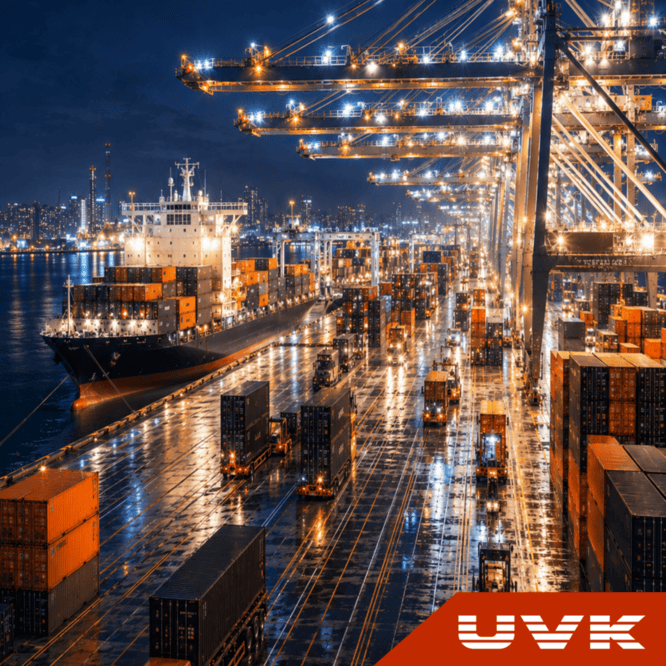
Modern logistics is increasingly rarely built around a single mode of transportation. Global supply chains have become so complex that efficient delivery often requires combining multiple solutions—road, rail, sea, and air transport. This is the foundation of multimodal logistics, which allows businesses to flexibly manage routes, reduce costs, and improve delivery reliability.
In 2026, multimodal transportation is no longer an alternative—it is gradually becoming the standard for international logistics. The reason is simple: no single transport mode can simultaneously provide maximum speed, minimum cost, and stability over long distances. Combining different transport solutions allows businesses to balance these factors and adapt logistics to specific operational needs.
What Multimodal Transportation Is and How It Works
Multimodal transportation is a logistics model in which a single shipment is delivered using at least two different modes of transport within one route. The entire process is managed as a unified system with a single plan, single responsibility, and coordinated timelines.
The key feature of this model is that the customer receives not separate transport stages, but a complete end-to-end solution. The logistics operator manages the entire route—from pickup to final delivery—including transshipment, consolidation, customs clearance, and documentation support.
In practice, this functions as a continuous supply chain where each transport mode performs its optimal role.
Why Businesses Are Switching to Multimodal Solutions
The main driver behind the growing popularity of multimodal transportation is cost and time optimization. Relying on a single transport mode is often either too expensive or inefficient from a logistics perspective.
For example, air freight offers maximum speed but comes at a high cost. Sea freight, on the other hand, is the most cost-effective option for large volumes but requires significantly more time. Road and rail transport fall in between, offering a balance of cost and speed.
Combining these solutions allows businesses to design routes that best match their operational needs. This is why multimodal logistics has become a core tool for international trade.
Main Combinations of Transport Modes
The most common model is the combination of sea and road transport. In this case, the main part of the route is carried out by sea, ensuring low transportation costs, while final delivery is completed by truck to the warehouse or end recipient.
Another effective combination is rail plus road transport. This is widely used for continental shipments where stability and predictable transit times are essential.
Air transport is often integrated into multimodal schemes for urgent or high-value goods. In such cases, air freight is used for the most time-sensitive segment of the route, while the rest is covered by road transport.
The Role of the Logistics Operator in Multimodal Transportation
In multimodal logistics, the operator plays a central role in coordinating all stages of transportation. The operator is responsible for transport synchronization, schedule control, documentation, and risk management.
Unlike traditional models where each carrier is responsible only for its segment, multimodal systems centralize responsibility. This significantly simplifies communication for the client and reduces potential points of failure.
The operator also ensures real-time route optimization. If delays or changes occur, the logistics scheme can be quickly adjusted without losing overall control of the shipment.
Economic Advantages of Multimodal Logistics
One of the main benefits of multimodal transportation is the reduction of total logistics costs. By combining different transport modes, companies can avoid excessive expenses at specific stages of delivery.
Additionally, multimodal logistics enables more efficient use of transport resources. For example, sea and rail transport provide high capacity, while road transport optimizes last-mile delivery.
Another economic advantage is reduced downtime. Properly planned logistics minimize time spent in transit hubs, improving inventory turnover and overall supply chain efficiency.
Challenges and Complexity of Multimodal Transportation
Despite its advantages, multimodal logistics is a complex system requiring precise planning. The main challenges are coordination between different transport modes, schedule alignment, and transshipment management.
Customs clearance is another critical complexity, especially when routes pass through multiple countries. Poor synchronization of documentation can lead to delays and additional costs.
Infrastructure dependency is also a key factor. Congested ports, limited terminal capacity, or shortages of rolling stock can affect the stability of the entire supply chain.
Digitalization as the Foundation of Efficiency
Modern multimodal transportation is impossible without digital technologies. Transportation management systems (TMS), tracking platforms, and analytics tools enable real-time control of each stage of the route.
Digitalization provides transparency for businesses, allowing them to monitor shipments, predict delivery times, and respond quickly to any changes. This significantly improves logistics control and reduces risks.
Conclusion
Multimodal transportation is a modern standard in international logistics that allows businesses to combine the advantages of different transport modes within a single solution. It provides flexibility, cost efficiency, and high delivery reliability.
In a world where speed and accuracy of supply chains are key competitive factors, multimodal logistics enables companies to build stable, scalable, and optimized supply chains adapted to real global market conditions.