
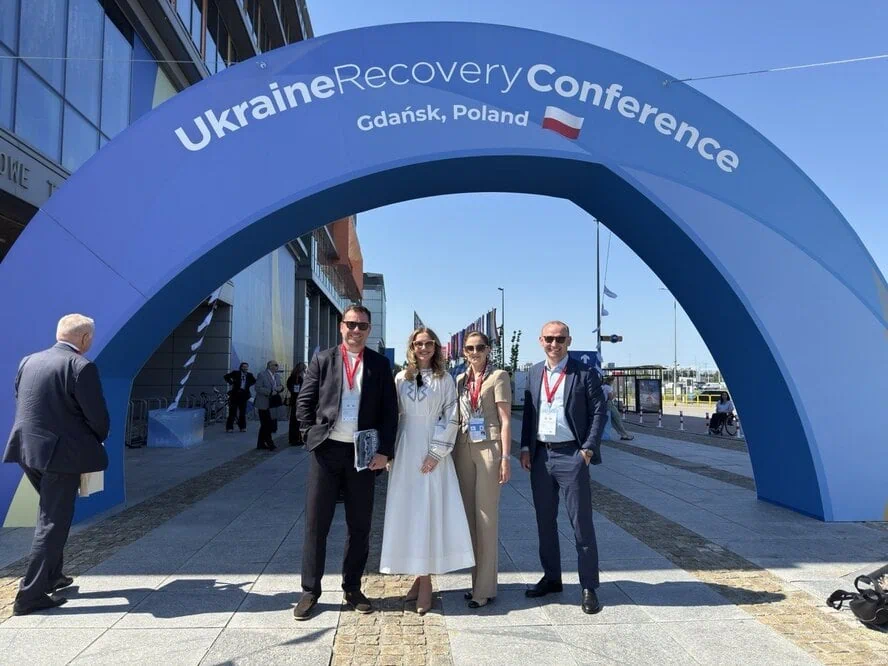
Two days in Gdańsk — and over 160 signed agreements worth more than €10 billion. I was there, among seven and a half thousand participants, and the most important thing I brought back wasn’t the numbers. The numbers are just the surface. What really happened in Gdańsk was a shift in the logic of the conversation about Ukraine’s recovery.
From Donations to Investment
A few years ago, Ukraine recovery conferences were mostly about the scale of destruction and the need for aid. Gdańsk spoke a different language.
Mikael Björknert, Chairman of the Supervisory Board of PrivatBank, put it plainly: the most important thing the international community can do for recovery is to start investing in it — not just donating. And this isn’t a thesis from the stage. PrivatBank — Ukraine’s largest, with 18 million customers — recorded business lending portfolio growth of over 60% last year. Nearly 40% of approved loans are investment loans: companies borrowing not for working capital but for equipment, expansion, and the future. This isn’t the behaviour of an economy waiting for recovery to arrive. This is an economy that is already recovering.
The scale, meanwhile, remains sobering. Ukraine’s total reconstruction needs are estimated at nearly $588 billion over a ten-year horizon — almost three times the country’s annual GDP. The World Bank estimates that private capital could cover around 40% of that figure. Grants and guarantees won’t be enough. Investment is needed. And that, in essence, is an invitation to business.
What Was Signed in Gdańsk
Prime Minister Yulia Svyrydenko summed it up: 160 agreements, over €10 billion in two days — a record across the entire history of Ukraine recovery conferences.
Among the key outcomes:
€3.2 billion — the first tranche of the Ukraine Support Loan, the EU’s new financial instrument for Ukraine under a €90 billion programme.
$3.4 billion — a new agreement with the World Bank to support the budget and advance reforms.
€470+ million — an EIB Group package: loans, grants and guarantees for housing, transport connectivity and private sector growth.
€260 million — initial commitments to the European Flagship Fund for the Reconstruction of Ukraine, focused on critical infrastructure, energy, transport and logistics, with a target of reaching ~€1 billion over the coming years.
€500+ million — new EBRD investment, bringing the bank’s total support for Ukraine during the war to €10.5 billion.
And separately — risk insurance. The US International Development Finance Corporation and MIGA (World Bank Group) signed a framework agreement on political risk insurance for investments in Ukraine. For private capital, this is fundamental: without the distribution of war and political risks, major investment decisions simply don’t get made.
Infrastructure and Logistics: From Words to Projects
The infrastructure block deserves particular attention — and, I’ll admit, my personal interest. For the first time, it was structured not as a thematic track but as a full investment platform built around four pillars: transport connectivity, energy resilience, digital transformation, and regulatory alignment with the EU.
Context matters here. Ukraine’s infrastructure is no longer purely a domestic network. It is part of Europe’s supply system, agricultural export routes, military-civilian mobility, and integration into the EU single market.
One practical outcome was the Ukraine Transport Support Fund — an initiative of Ukraine, Sweden, Lithuania, Canada and the International Transport Forum. In Gdańsk, Lithuania, Sweden, Estonia and Ukraine signed a joint declaration of support. The fund’s logic differs from large-scale programmes: financing small and medium-sized projects in road, rail, maritime and logistics infrastructure. Repairing critical sections, equipping border crossings, supporting export routes — without this, major transport corridors simply don’t function.
The Ministry of Communities and Territories presented a portfolio of over 30 PPP projects worth approximately $5 billion: concessions for the ports of Chornomorsk, the Northern Bypass of Lviv, modernisation of the Yahodyn–Kovel–Lutsk corridor, reconstruction of the M-15 Odesa–Reni route, and the Sknylivintermodal hub. Fifteen of these have been identified as priorities for launch in 2026.
This represents a change in tone. Ukraine is no longer reporting on the scale of its needs. It is reporting on progress in project preparation — from concept to feasibility study to tender.
Business Is Coming to Ukraine. Logistics Is One of the First Questions
Behind all the funds, declarations and memorandums is one simple question I heard in Gdańsk again and again — in conversations with infrastructure players, people from rail and ports, foreign companies just beginning to look at the market: how do you actually organise business operations in Ukraine?
When a foreign company enters a new market, it doesn’t need a consultant to explain how Ukrainian logistics works. It needs a partner who already knows the routes, customs procedures, warehouse infrastructure and regional specifics — and simply gets on with the job.
That’s what we at UVK have been doing for over twenty years. We are Ukraine’s first domestic 3PL operator, in the market since 2001. Class A/A+ warehouse complexes in five cities: Kyiv, Kharkiv, Dnipro, Lviv, Odesa. Nationwide distribution, international freight, customs clearance. Twenty years in a country that is now at the centre of the world’s attention.
Complex logistics is our everyday work. And when I tell an international partner that we operate where others stop — that’s not marketing. It’s what we do every day.
Instead of a Conclusion
One of the key takeaways from Gdańsk can be put this way: URC is no longer a conference of needs. It is the starting gun for real projects.
Business looking at Ukraine as a market has no time to wait for the perfect moment. Recovery is already underway. Infrastructure is being built. Capital is being mobilised. The next URC takes place in January 2027 in Tallinn. By then, much will have been decided in practice — not at conferences.
Evgeny Navrotsky,
CEO, UVK