
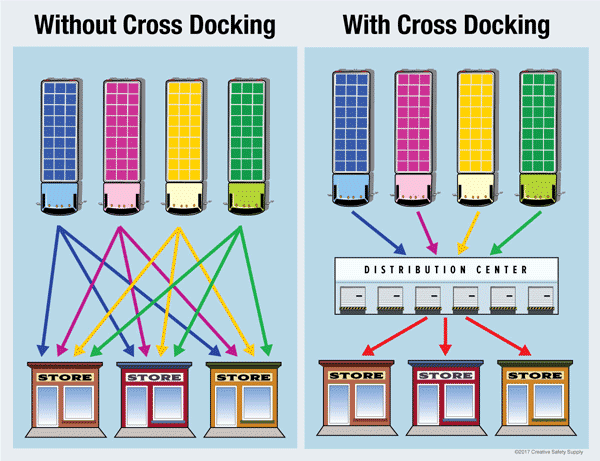
In modern logistics, the speed of product movement has become one of the key factors of business efficiency. Companies no longer compete only on price or assortment—delivery speed and supply chain efficiency increasingly determine market advantage. As a result, traditional warehousing models are being supplemented or partially replaced by more flexible solutions. One of these is cross-docking—a logistics approach that minimizes or completely eliminates long-term storage.
Cross-docking is especially relevant for companies operating in retail, e-commerce, distribution, and FMCG sectors. In environments where fast inventory turnover and uninterrupted supply are critical, every extra hour spent in a warehouse translates into additional costs and reduced efficiency. Therefore, businesses are increasingly shifting toward logistics models where goods do not “sit” in storage but move through the system almost immediately after arrival.
What Cross-Docking Is and How It Works
Cross-docking is a logistics model in which goods arrive at a distribution facility or warehouse but are not placed into long-term storage. Instead, they are immediately sorted, consolidated, or redistributed and then shipped onward to their final destinations.
In this model, the warehouse functions not as a storage facility but as a transit hub. Goods may stay at the site from a few hours up to one or two days, but they do not remain in the system longer than necessary for processing.
This approach fundamentally changes the logic of supply chain operations. Instead of accumulating inventory and distributing it later, companies operate on a continuous flow principle.
Main Types of Cross-Docking
In logistics practice, several core cross-docking formats are used depending on product type, supply structure, and business model.
The most common is transit cross-docking, where cargo arrives on one vehicle and is immediately transferred to another without storage. This format is especially effective in international logistics, where fast transfer between transport modes is required.
Another format is consolidation cross-docking. In this case, goods from multiple suppliers are collected at a logistics hub and then grouped into new shipments based on delivery routes or customer orders. This helps optimize transportation costs and reduce the number of shipments.
There is also a redistribution model, where large shipments are broken down into smaller consignments and delivered to multiple retail locations, regional warehouses, or distribution centers. This approach is widely used in retail and national distribution networks.
Why Businesses Are Moving Away from Traditional Warehousing
Traditional warehousing involves storing goods for a certain period before further dispatch. This creates multiple cost components: warehouse rent, staffing, inventory management, product depreciation risks, and storage overhead.
In many cases, these costs are not justified—especially for fast-moving goods or products with stable demand. Cross-docking reduces or eliminates storage costs because goods are not held in inventory for long periods.
Additionally, the need for large warehouse infrastructure decreases. The logistics facility becomes more compact but significantly more efficient in terms of throughput and processing speed.
Key Benefits of Cross-Docking for Business
The primary advantage of cross-docking is significantly faster supply chain movement. Eliminating long-term storage allows products to reach end customers much faster, which is critical in highly competitive markets.
Another important benefit is cost reduction. Companies avoid expenses related to long-term warehousing and instead pay only for handling and transportation operations.
Cross-docking also improves accuracy and control in logistics operations. With fewer handling steps, the risk of errors, misplacement, or inventory loss is significantly reduced.
Value-Added Processing Without Delays
Modern logistics hubs operating under a cross-docking model can perform additional value-added services without moving goods into separate storage areas. These may include labeling, sticker application, promotional kit assembly, repackaging, or quality control.
All these operations are performed directly at the arrival point, maintaining process speed and avoiding unnecessary delays in the supply chain.
Which Businesses Benefit Most from Cross-Docking
Cross-docking delivers the greatest value in industries with high inventory turnover. These include retail chains, FMCG distributors, e-commerce businesses with high order volumes, and companies operating regular regional replenishment flows.
It is also highly effective in international logistics, where minimizing transit time and ensuring fast redistribution between transport modes are critical.
Conclusion
Cross-docking is not just an alternative to traditional warehousing—it is a modern logistics model that enables businesses to operate faster, more efficiently, and at lower cost. It transforms warehouses from storage facilities into dynamic logistics hubs.
In a world where delivery speed is a critical competitive factor, cross-docking helps companies reduce costs, improve service quality, and ensure supply chain stability. As a result, it is increasingly becoming a standard approach in modern logistics systems.